
Need SR-22 insurance assistance?
 CALL our licensed Agents
(Mon-Fri, 8am – 5pm PST) for personalized guidance CALL our licensed Agents
(Mon-Fri, 8am – 5pm PST) for personalized guidance |
If you need to reinstate your Texas driver’s license after a DUI conviction but don’t own a vehicle, non-owner SR22 insurance provides the financial responsibility certification you need. This liability-only policy covers damages you cause while driving borrowed or rented vehicles and satisfies Texas DPS requirements. You’ll typically maintain this coverage for three years, with premiums varying based on your driving record. Understanding the specific coverage limits and filing requirements will help you navigate the reinstatement process efficiently.
Key Takeaways
- Non-owner SR22 insurance provides liability coverage for Texas drivers without vehicles who need to reinstate privileges after DUI/DWI or serious violations.
- Texas requires continuous SR22 filing for three years, with any coverage lapse triggering immediate license suspension and timeline reset.
- Policy costs vary based on driving record, age, and violations, with separate SR22 filing fees ranging from $15 to $50.
- Non-owner SR22 only covers occasional use of borrowed vehicles and excludes owned, leased, or regularly accessed vehicles in your household.
- Compare quotes from multiple insurers like Progressive, GEICO, and State Farm to find affordable non-owner SR22 coverage in Texas.
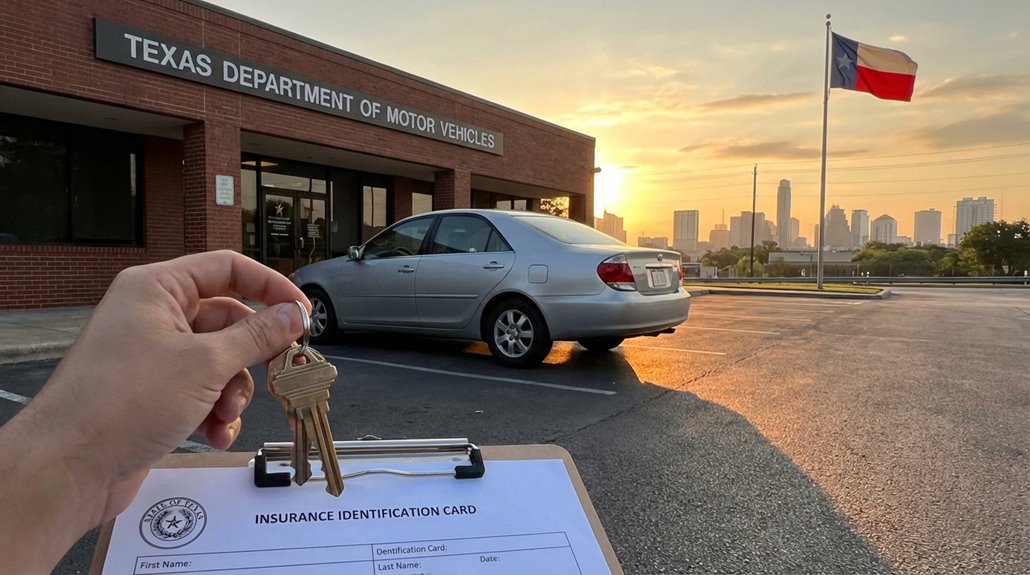
What Is Non-Owner SR22 Insurance in Texas
When you need to reinstate your driving privileges after a serious traffic violation but don’t own a vehicle, non-owner SR22 insurance provides the solution Texas requires. This certificate proves you carry the state-mandated minimum liability coverage despite not having a registered vehicle in your name.
Non-owner SR22 insurance functions as a liability-only policy that covers damages you cause while driving borrowed or rented vehicles. It doesn’t cover the vehicle itself or any injuries you sustain.
Texas law mandates this filing for drivers convicted of DUI/DWI, driving without insurance, or accumulating excessive violations.
You’ll file the SR22 form through your insurance provider directly with the Texas Department of Public Safety. The state typically requires you to maintain this coverage continuously for three years to keep your license valid.
Who Needs Non-Owner SR22 Insurance
Understanding the general requirements helps, but determining whether you specifically need non-owner SR22 insurance depends on your particular circumstances and driving history.
You’ll typically need non-owner SR22 insurance if you:
- Don’t own a vehicle but must maintain SR22 certification after a DUI/DWI conviction
- Had your license suspended for accumulating excessive points
- Were convicted of driving without insurance
- Need to reinstate your license after a serious traffic violation
- Frequently borrow or rent vehicles while under SR22 requirements
Texas courts and the DPS mandate SR22 filings for specific violations.
If you don’t own a car but still need driving privileges, non-owner coverage satisfies the state’s financial responsibility requirements. This policy proves you’re carrying minimum liability coverage, even without a registered vehicle in your name.
Common Reasons Texas Requires SR22 Filing
Texas law mandates SR22 filings for violations that demonstrate significant risk to public safety or financial irresponsibility on the road.
You’ll typically need an SR22 after specific serious offenses that trigger the state’s financial responsibility requirements.
Primary triggers for SR22 requirements include:
- DUI or DWI convictions
- Driving without valid insurance
- Accumulating excessive traffic violations
- At-fault accidents while uninsured
- License suspension or revocation
- Failure to pay court-ordered judgments from accidents
The Texas Department of Public Safety requires you to maintain SR22 certification for two years following most violations.
If you’re caught driving without a vehicle but need to reinstate your license, non-owner SR22 insurance satisfies this mandate.
Each violation carries specific consequences, and the SR22 serves as proof you’ve met Texas’s minimum liability coverage requirements.
How Non-Owner SR22 Differs From Standard SR22 Policies
Meeting your SR22 filing requirement doesn’t always mean purchasing a traditional auto insurance policy. Non-owner SR22 insurance provides liability coverage when you drive vehicles you don’t own, while standard SR22 attaches to a policy covering a specific vehicle you’ve registered.
Non-owner SR22 insurance lets you meet state filing requirements without owning a vehicle.
Key distinctions between these policy types include:
- Coverage scope: Non-owner policies exclude vehicles in your household or available for regular use
- Premium costs: Non-owner SR22 typically costs less since there’s no physical asset to insure
- Vehicle requirements: Standard SR22 requires you to own and register a vehicle; non-owner doesn’t
- Liability limits: Both must meet Texas’s minimum coverage requirements
- Filing purpose: Both satisfy state-mandated SR22 certification obligations identically
You’ll choose based on whether you currently own a vehicle requiring registration.
Coverage Limits and Liability Requirements in Texas

Every non-owner SR22 policy in Texas must meet the state’s mandatory minimum liability limits: $30,000 for bodily injury per person, $60,000 for bodily injury per accident, and $25,000 for property damage—commonly written as 30/60/25.
These minimums represent the baseline legal requirement, but you should consider higher limits. If you cause an accident exceeding your coverage, you’re personally liable for the difference. Many drivers opt for 50/100/50 or 100/300/100 coverage for stronger financial protection.
Your non-owner SR22 provides liability coverage only—it won’t cover your injuries or damage to the vehicle you’re driving.
Texas law requires you to maintain continuous coverage for the SR22 filing period, typically three years. Any lapse triggers automatic notification to the DPS, potentially resulting in license suspension and filing period restarts.
How to Obtain Non-Owner SR22 Insurance in Texas
Securing non-owner SR22 insurance in Texas requires a straightforward but specific process.
You’ll need to contact an insurance provider authorized to file SR22 certificates with the Texas Department of Public Safety.
Follow these essential steps to obtain your coverage:
- Verify your SR22 requirement by reviewing your court order or DPS correspondence
- Request quotes from multiple insurers specializing in high-risk policies
- Purchase a non-owner liability policy meeting Texas minimum coverage requirements
- Authorize your insurer to file the SR22 electronically with the DPS
- Confirm filing completion and retain proof of your certificate
Your insurer must transmit the SR22 form directly to the state.
Coverage typically activates within 24-48 hours of filing, though you should verify your license reinstatement status with the DPS.
Cost Factors for Non-Owner SR22 Policies

Once you’ve initiated the SR22 filing process, understanding the cost factors becomes your next priority. Several variables directly impact your non-owner SR22 policy premium.
Your driving record carries the most weight. DUI convictions, multiple violations, or at-fault accidents considerably increase rates. Insurance companies view these infractions as high-risk indicators, adjusting premiums accordingly.
The SR22 filing fee itself typically ranges from $15 to $50, charged separately from your policy premium. Your age, gender, and coverage limits also influence costs. Younger drivers generally face higher rates due to statistical risk profiles.
Geographic location matters too—urban areas in Texas often command higher premiums than rural regions.
Shopping among multiple insurers remains essential, as rate calculations vary markedly between companies for identical coverage profiles.
How Long You Must Maintain SR22 Coverage in Texas
Texas law requires you to maintain SR22 coverage for a minimum of two years from your filing date, though certain violations may extend this period to three years or longer.
Your SR22 clock resets if coverage lapses for any reason. The Texas DPS monitors your filing status continuously and will suspend your license immediately upon notification of cancellation.
Any gap in your SR22 coverage resets your timeline completely—Texas DPS won’t give you a grace period.
Factors affecting your SR22 duration:
- DWI convictions typically require three-year filings
- Multiple offenses may extend requirements beyond standard periods
- Out-of-state violations can impact Texas filing timelines
- License reinstatement delays don’t reduce your obligation
- Court-ordered periods may exceed state minimums
You must maintain continuous coverage throughout the entire mandated period.
Even a single day without active SR22 filing restarts your timeline and triggers automatic license suspension.
What Happens If Your Non-Owner SR22 Policy Lapses
A lapse in your non-owner SR22 policy triggers immediate and serious consequences under Texas law.
Your insurance company must notify the Texas DPS within 30 days of any cancellation or non-renewal. Once DPS receives this notification, they’ll suspend your driver’s license immediately.
You’ll face several penalties if your coverage lapses.
DPS will require you to restart your SR22 filing period from the beginning, extending your mandatory coverage timeline. You’ll also pay a license reinstatement fee of $100 to restore your driving privileges.
Additionally, driving without valid SR22 coverage constitutes a Class C misdemeanor in Texas. If caught, you’ll face fines up to $500 and potential vehicle impoundment.
Maintaining continuous coverage isn’t optional—it’s a legal requirement that protects your license and prevents costly penalties.
Reinstating Your Texas Driver’s License With SR22
Before you can legally drive again in Texas, you’ll need to complete a specific sequence of steps to reinstate your suspended license with an SR22.
Reinstating a suspended Texas license requires following precise steps—with SR22 certification being the critical piece of the puzzle.
Required Steps for License Reinstatement:
- Pay all outstanding reinstatement fees to the Texas DPS (typically $100-$125)
- Obtain SR22 certification from a licensed Texas insurance provider
- Confirm your insurer files the SR22 electronically with DPS
- Clear any additional court-ordered requirements or fines
- Verify your driving record shows active SR22 status
Once DPS receives your SR22 filing, processing typically takes 24-72 hours. You can check your license status through the DPS online portal.
Don’t drive until you’ve received official confirmation of reinstatement. Driving on a suspended license carries severe penalties, including extended suspension periods and potential criminal charges.
Limitations of Non-Owner SR22 Insurance
While non-owner SR22 insurance fulfills Texas’s financial responsibility requirements, it comes with significant coverage restrictions you must understand before purchasing a policy.
Non-owner SR22 policies don’t cover vehicles you own, lease, or have regular access to. If you frequently borrow a family member’s car, that vehicle won’t receive protection under your policy. The coverage applies only to occasional, incidental use of borrowed vehicles.
These policies exclude extensive and collision coverage entirely. You’re protected for liability only, meaning damage to the vehicle you’re driving isn’t covered.
Additionally, non-owner policies won’t cover commercial driving activities or vehicles used for business purposes. If you’re transporting goods or passengers for compensation, you’ll need separate commercial coverage.
You should also note that household vehicles require their own standard auto insurance policies regardless of your SR22 status.
Transitioning From Non-Owner to Standard Auto Insurance
Once you’ve acquired a vehicle, you’ll need to convert your non-owner SR22 to a standard owner’s SR22 policy without any gap in coverage.
Contact your insurer immediately upon vehicle purchase to initiate the changeover.
Key steps for a compliant changeover:
- Notify your insurer before driving your new vehicle to arrange coverage transfer
- Maintain continuous SR22 filing throughout the changeover to avoid license suspension
- Verify liability limits meet Texas minimums (30/60/25) on your new policy
- Confirm SR22 endorsement transfer with the Texas DPS
- Obtain proof of insurance before operating your vehicle
Your insurer will file an updated SR22 certificate reflecting your new owner’s policy.
Any coverage lapse, even briefly, triggers DPS notification and potential license revocation, extending your SR22 requirement period.
Finding Affordable Non-Owner SR22 Insurance Providers in Texas
Several Texas insurers specialize in high-risk coverage and offer competitive non-owner SR22 policies, though rates vary considerably between providers.
You’ll find the most competitive rates by requesting quotes from at least three to five companies that actively write SR22 filings.
Contact insurers directly rather than relying solely on online quotes, as agents can identify discounts you might otherwise miss.
Speaking directly with insurance agents often uncovers discounts that online quote tools simply cannot detect.
Progressive, GEICO, and State Farm commonly underwrite non-owner SR22 policies, while specialty carriers like The General and SafeAuto focus specifically on high-risk drivers.
When comparing policies, examine more than just premium costs.
Verify each insurer’s financial stability rating and confirm they’ll file your SR22 electronically with the Texas DPS.
Ask about payment flexibility, as some providers require full payment upfront while others offer monthly installments.

Frequently Asked Questions
Can I Get Non-Owner SR22 Insurance if I Have an Out-Of-State License?
Like maneuvering through a maze with two maps, you’ll face complications. You typically can’t obtain Texas non-owner SR22 insurance with an out-of-state license. Texas insurers require a valid Texas driver’s license for SR22 filings.
Does Non-Owner SR22 Insurance Cover Rental Cars in Texas?
Yes, your non-owner SR22 insurance typically covers rental cars in Texas. You’ll receive liability protection when you rent vehicles, satisfying state requirements. However, you should verify coverage limits and any exclusions with your insurer before renting.
Will My Non-Owner SR22 Policy Follow Me if I Move States?
Your Texas non-owner SR22 won’t automatically pack its bags with you. You’ll need to file a new SR22 in your destination state, as each state maintains separate filing requirements and compliance standards.
Can I Be Denied Non-Owner SR22 Insurance in Texas?
Yes, insurers can deny you non-owner SR22 coverage based on your driving record severity, claim history, or risk assessment. However, Texas has assigned-risk programs ensuring you’ll find coverage through high-risk specialty carriers if standard insurers decline.
Does Non-Owner SR22 Insurance Affect My Credit Score in Texas?
Your non-owner SR22 insurance doesn’t directly affect your credit score in Texas. However, insurers may check your credit when setting premiums, and missed premium payments could negatively impact your credit if sent to collections.
Conclusion
You’ve now got the roadmap to navigate Texas non-owner SR22 insurance requirements. Whether you’re reinstating your license, meeting court mandates, or preparing to shift back to standard coverage, compliance is your priority. Don’t delay—file promptly, maintain continuous coverage, and protect your driving future. The road to reinstatement isn’t complicated; it’s simply a matter of taking the right steps, at the right time, with the right provider.
Related Posts:




| Need SR-22 insurance assistance?
CALL our licensed Agents
(Mon-Fri, 8am – 5pm PST) for personalized guidance |